Urban geographies of autonomous driving
The self-driving car and its multi-scalar infrastructures of testing, sensing, and labour (postdoctoral project)
This project examines the challenges of professional space makers confronted with the accelerating urban presence of autonomous vehicles (AVs). It starts from the hypothesis that the advancing implementation of AVs in select cities worldwide forces us to rethink inherited understandings of the urban built environment, its multi-scalar infrastructural governance, and its representation through powerful urban imaginaries. Across different spatial scales, the project explores new actor constellations in the field of autonomous driving that not only reshape the city’s existing physical, but also its newly emerging digital infrastructures. Building on critical urban theory, digital geography, and AI studies, it uses ethnographic methods such as interviews, participatory observations, and qualitative content analyses to foreground autonomous driving as a key arena of urban future-making.
- critical urban methodology
- ethnography of infrastructure (Star 1999)
- interviews with AV experts, state coordinators, and data workers
- qualitative analysis of policy documents and socio-technical imaginaries
Context
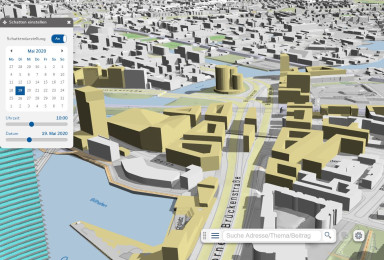
My project investigates local settings of AV deployment as well as the wider socio-economic contexts of AV implementation. These contexts bring professionals face to face with spatial and temporal tensions of urban future-making. On a spatial level, I shed light on the manifold conflicts of global AV supply chains that connect data workers in the Global South with sites of local AV deployment in cities of the Global North. On a temporal level, I show that space makers in the field of autonomous driving are constantly challenged to minimise the time lag between changes in the real built environment and the representation of such changes in digital models such as HD maps.
Aims
The project pursues two principal aims. First, it identifies those professional space makers centrally shaping the progressing implementation of AVs in local urban settings, including technology companies, urban administrators, transport planners, researchers, and data workers. The project’s second aim is a deeper understanding of those multi-scalar, globally networked infrastructures that space makers in the field of autonomous driving need to navigate, with a particular focus on:
Infrastructures of testing as found in proliferating AV pilot projects, test fields, and AV experiments
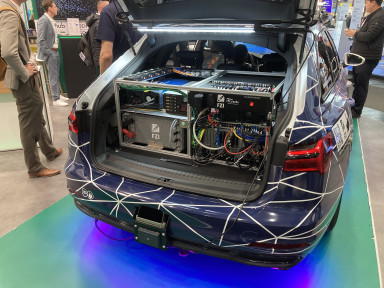
Infrastructures of sensing as embodied by the diverse apparatuses of machine vision and data capture needed for the safe navigation of AVs
Infrastructures of labour that provide global pools of data workers for the production of high-quality AV training datasets