23 Jun, 2026, 17:00Auditorium, HCU
Prof. Dipl. Arch. Dirk Hebel (Karlsruhe Institute of Technology)
On breeding, harvesting, and collecting future building materials
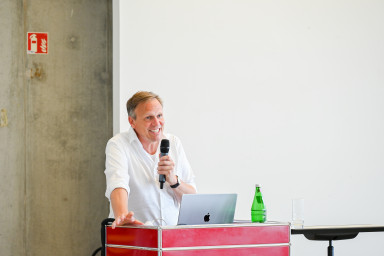
Image © Anastasija Lösslein.
Abstract
The world’s population has been growing steadily for decades. At the same time, economic prosperity is increasing. Both developments are leading to growing pressure on our natural environment, our climate, and our resources. The vast majority of the materials we use for construction are currently extracted from the earth’s crust, used, and then disposed of. They are, quite literally, consumed and not borrowed from natural or technological cycles to be reintegrated into them. This linear approach, still powered by fossil fuels, has profound consequences for our planet. We are deeply interfering with existing ecosystems and destroying our own life support systems, as evidenced by climate change. The built environment must therefore be understood as a temporary repository of raw materials in an endless cycle – a radical paradigm shift is needed. We urgently need new principles for the construction, deconstruction, and continuous transformation of our built environment. At the same time, we must answer the question of how to provide new materials that meet the requirements of a circular economy while simultaneously avoiding further CO2 emissions. We must increasingly strive for a shift towards regenerative cultivation, the breeding and cultivation of resources and building materials, instead of continuing to rely on finite resources. These processes must be driven by renewable energies, which must prioritize the issue of emissions in the issuance of building permits and funding programs, rather than solely focusing on primary energy consumption.
Bio
Dirk E. Hebel is an architect trained at ETH Zurich and Princeton University. Currently, he is a professor of sustainable construction and vice dean for strategic development at the Faculty of Architecture at the Karlsruhe Institute of Technology (KIT). His research focuses on circular and emission-free design and construction. He is the editor of numerous books, most recently Zirkulär! (Birkhäuser Verlag, 2026, with Annette Hillebrandt), Sortenrein Bauen (DETAIL Verlag, 2023, with Ludwig Wappner et al.), and Building with Natural Materials (Fraunhofer IRB Verlag, 2024, with Sandra Böhm and Elena Boerman). As faculty representative, together with Andreas Wagner, he won the international university competition Solar Decathlon Europe 2021–22 as part of the RoofKIT team, with Regina Gebauer and Nicolas Carbonare. He is a member of the Association of German Architects (BDA) and works as a practicing architect in the firm 2hs Architekten und Ingenieur (2hs Architects and Engineers), which he co-founded, focusing on resource-efficient construction and the use of circular materials. Together with Werner Sobek and Felix Heisel, he completed the highly regarded Urban Mining and Recycling building project UMAR within the NEST project of EMPA in Dübendorf near Zurich. With Felix Heisel and Karsten Schlesier, as well as Lisa Krämer and Simon Sommer, he designed the Mehr.WERT.Pavillon (Added Value Pavilion) for the Baden-Württemberg State Office for the Environment at the Federal Garden Show in Heilbronn.