06 Jan, 2026, 17:00Auditorium, HCU
Univ.-Prof. Dr. Alexa Färber (University of Vienna)
Making futures by promises? An urban anthropological perspective on housing as an object of (political) desire
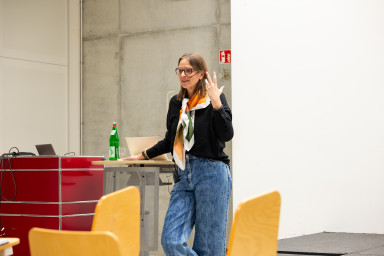
Image © Anastasija Lösslein.
Abstract
Urban politics is full of promises, but not every promise is heard or becomes an object of political desire for others; even fewer promises are fulfilled. This binding yet non-binding quality of promises plays a role in shaping the future of urban society. It is therefore worthwhile to take the mechanisms and conditions of promises seriously from an analytical perspective. From a cultural studies perspective, I would like to propose to examine cities as a ‘promissory assemblage’. This allows for an opening up of analytical perspectives on the temporality of future-making promises, the binding nature of the social connections they articulate, and their narrative power – and their inconsistencies.
Using the example of the feature film Les promesses (The promises; Thomas Kruithof, 2022) and the documentary Appartement proche Paris, charme atypique (Apartment close to Paris, atypical charm; Marion Angelosanto, 2024), which explore the housing market in the Parisian banlieues, I investigate the conditions for the often conflict-laden effectiveness of promises. How exactly do promises become clusters and objects of political desire? What forces are at work in this process? And is the field of the housing market particularly specific in this regard? My interest lies in the highly ambivalent potential of promises; by this, I mean that what constitutes a joyful promise for one person can be a threat to another. Moreover, the joyful engagement with a cluster of promises can transform into an exhausting attachment to an ‘object of (political) desire’.
Bio
Alexa Färber is a professor of European Ethnology at the Department of European Ethnology at the University of Vienna. Her research and teaching focus on urban research from a cultural studies perspective, the anthropology of knowledge, and multimodal methodologies. Combining these fields and related methods, she has worked and published extensively, presenting concepts such as the ‘tangibility of the city’ (2010), ‘low-budget urbanity’ (2016), the city as a ‘promissory assemblage’ (2019), and, with Alexander Martos, ‘objects of political desire’ (2024). Her practical and epistemological interest in inter- and transdisciplinary working contexts has led to the development of long-term research networks, such as the French-German research network Penser l'urbain par l'image, as well as various shorter research projects, including Klimarechnungshof.jetzt! (Austrian Science Fund, FWF) and Infrastructuring Libraries in Transformation (Urban Europe, EUNTC, 2022–2025). In a long-term study based in Paris, she is investigating the effects and affects of promises in this fragmented urban society.